

Lime Hills Academy is a SEMH Special School located on two temporary sites-one in Nailsea (Year 5, 6 and 7) and one in Weston (Year 8, 9, 10 and 11)
The policy is written in line with the 2014 Children’s and Families Act 2014, the Special Educational Needs and Disability (SEND) Code of Practice and the Equality Act 2010.
It sets out our vision and principles for children and young people with SEND and expectations for all our academies across the Trust.
At Lime Hills Academy, our purpose is to provide a nurturing environment where students feel known, accepted, and loved. Personalised learning plans are tailored to individual student needs. By building strong relationships grounded in care and high expectations, we empower students to unlock their potential to achieve success, growth, and pride on their own terms. We are committed to helping students feel a sense of belonging and to have a voice, enabling them to reflect on their journey, appreciate their achievements, and walk confidently towards their future.
Children at Lime Hills Academy will be supported to develop self-regulation and a broader window of tolerance in their daily life so that they can access academic opportunities at their point of readiness. Each child will have a different range of needs and hence a different range of opportunities and interventions, and the curriculum will be designed around an understanding of the individual: no two curricula will look the same.
The staffing structure will support children to access learning through being more regularly in optimum arousal stage: this will be enabled by ensuring children are attached or allocated to three key staff, helping them to build relationships over time and enabling them to feel safe and thrive, even in the face of change. The small number of people working with each individual enables optimal arousal to learn, without the vulnerability associated with ensuring trusted connections with only one adult.
The day will involve routine and structure which creates a feeling of safety, without the rigidity of a mainstream setting: staff will be trained and empowered to deviate from routine where appropriate to help an individual to make progress socially, emotionally or academically whilst maintaining the very highest expectations. Lime Hills meets the needs of those most in need of specialist intervention. This is underpinned by the core HEART values of the CLF.
The core purpose of the CLF is at the HEART of all we do. Our vision is simple: we believe that by working together rather than in isolation we can accelerate school improvement and embed excellence in our academies. In doing so, together we can create more opportunities for lifelong success for our students as they become young adults.
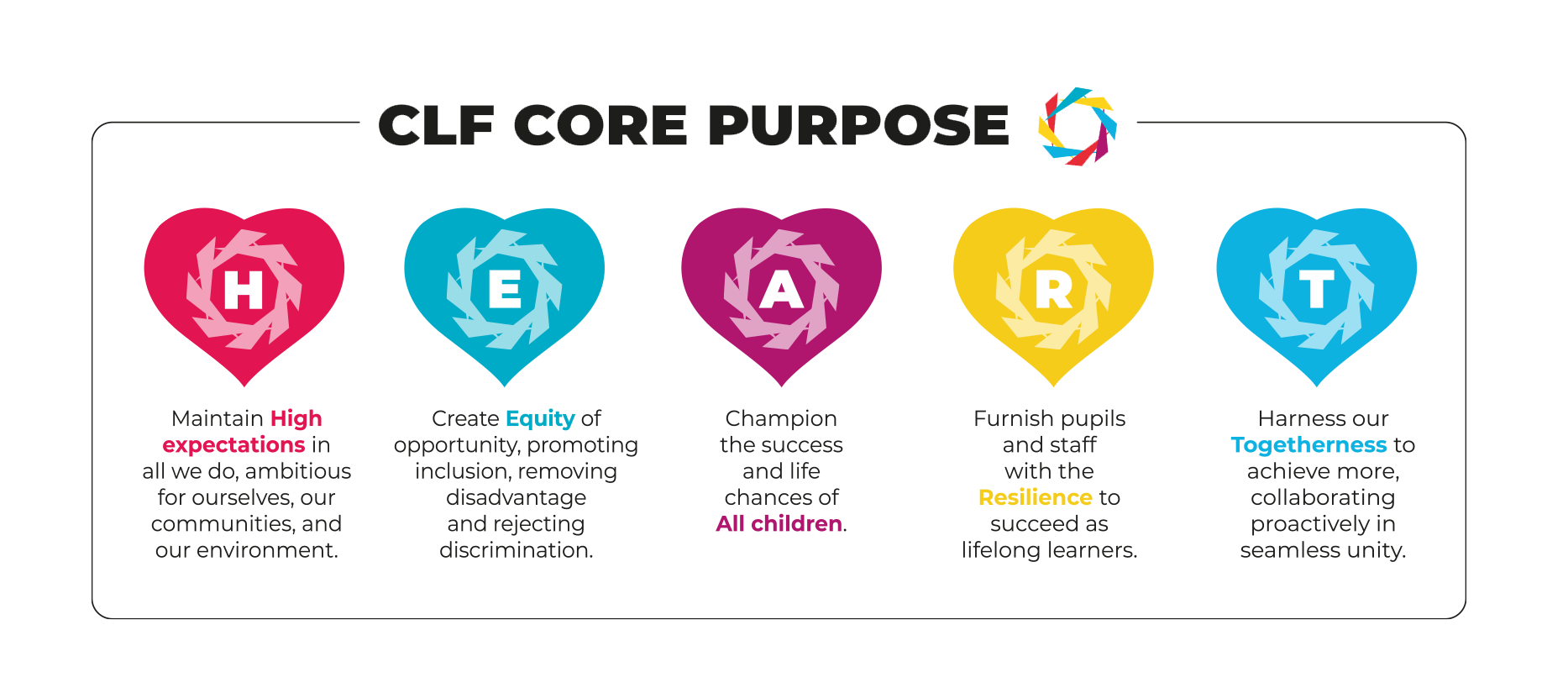
Our policy prioritises inclusion, ensuring every child's unique needs are met for success. We champion inclusivity, resilience, and the success of every child across all our academies. We create inclusive environments where every child, regardless of ability, disability, race, or background, feels valued and supported.
Our academy provides a broad, balanced, and accessible academic and social curriculum for all students. We believe in equity for everyone in our communities, fostering a positive learning culture where diversity is respected, and students feel safe and empowered to succeed.
In our commitment to every child and young person's success, we recognise that some may need extra support. Children may have SEND either throughout or at any time during their school career. Our policy adopts a child-centered approach, ensuring that plans and assessments are tailored to meet the individual needs of children and young people with SEND.
Our school values which underpin how we interact with all students and stakeholders are:

“Fairness does not mean everyone gets the same. Fairness means everyone gets what they need.” Rick Riordan, The Red Pyramid
Lime Hills Academy and its governing body recognise that all students have differing abilities, learning styles and rates of progression and operates an inclusive approach to all learning for all students to ensure the potential of every student is maximised irrespective of ability, disability, race, social origin, religion, gender and sexual orientation. Inclusion is the responsibility of all staff within Lime Hills Academy. Lime Hills Academy is ambitious for its students and will create a learning environment that enables all students to succeed and progress beyond their expectations. Inherent to this achievement is the promotion of a positive learning culture where all students recognise, value and enjoy the learning experience; respect diversity; are safe and feel safe; and gain the skills and attitudes they need for future success. In line with the 2014 SEND Code of Practice, Lime Hills Academy is committed to enabling children and young people with special educational needs and disabilities (SEND) to reach their full potential and support families to do the best for their children by adopting a multi-agency approach. The Governing Body will review the SEND policy annually.
We aim to provide equity and improve outcomes for all by:
This policy and information report is based on the statutory Special Educational Needs and Disability (SEND) Code of Practice (2015) and the following legislation:
A student has SEND if they have a learning difficulty or disability which calls for special educational provision to be made for them.
A child of school age or young person has a learning difficulty or disability if they have:
For children aged two or more, special educational provision is educational or training provision that is additional to or different from that made generally for other children or young people of the same age.
The SEND Code of Practice 2015 outlines four broad areas of Special Educational Need:
It is recognised that a child or young person may have interrelated and complex needs. We adopt a strengths-based, needs-led approach, recognising each learner’s unique profile of abilities alongside areas for development.
There is a clear distinction between ‘underachievement,’ often caused by a poor early experience of learning, and ‘special educational needs’. Some learners may be underachieving but will not necessarily have a special educational need; it is our responsibility to identify this quickly and ensure that appropriate support is put in place to help these learners ‘catch up.’
We are aware of emerging developments in national SEND reform and will continue to review our approach in line with updated guidance, as part of the ‘Every Child Thriving’ reform programme (February 2026).
As described in the Equality Act 2010, a child or young person has a disability if they have a physical or mental impairment which has a long-term (a year or more) and substantial adverse effect on their ability to carry out typical day to-day activities.
This includes, for example, sensory impairments such as those that affect sight and hearing, and long-term health conditions such as asthma, diabetes, epilepsy or cancer.
The Equality Act requires early years’ providers, schools, colleges, other educational settings, and local authorities to:
Children and young people must not be regarded as having a learning difficulty solely because the language of their home is different from the language in which they will be taught.
The term “EAL” is used to describe a diverse and heterogeneous group of learners who speak English as an Additional Language. In England, such learners are defined as those who have been 'exposed to a language at home that is known or believed to be other than English' (Department for Education, 2019). The child or young person may speak some English but has been brought up using a language other than English during early development and continues to be exposed to this language in the home and /or in the community.
Language is central to our identity, so we recognize and value the home languages of all students and staff. Children and young people who are new to English or developing it as an additional language will receive timely assessments, appropriate support and exam access arrangements within the first three years. They are entitled to the full curriculum. When identifying SEND needs, it is important to distinguish between language acquisition difficulties and actual learning disabilities. Early identification and a holistic understanding of each child or young person are crucial.
This policy complies with the statutory requirements laid out in the SEND Code of Practice 0 – 25 September 2014 3.65 and has been written with reference to the following Guidance and documents:
The policy has been written by the SENCO in liaison with academy counsellors and Principal.
As a specialist school, all students at Lime Hills Academy have an Educational Healthcare Plan (EHCP). Lime Hills Academy will ensure that the necessary provision is made for every student, and those needs are made known to all who are likely to teach them.
Lime Hills Academy will ensure that teachers and support staff are able to provide for the range of SEND needs through regular, relevant and appropriate training.
Lime Hills Academy will make reasonable adjustment for disabled students to ensure that they do not experience substantial disadvantage. Lime Hills Academy is committed to ensuring that all students with disabilities have appropriate access to the curriculum and the learning environment. Lime Hills Academy is committed to maximise the participation of all students and members of the academy community.
Lime Hills Academy will maintain a commitment to providing a balanced and broadly based curriculum, which will be personalised for each student.
Resources for SEND will be allocated on the basis of need.
The Principal, along with the Governing body will seek to allocate sufficient resources to support the effective provision of SEND.
Lime Hills Academy is committed to providing comprehensive support for learners with SEND, based on a graduated approach as outlined in the SEND Code of Practice (2015). This is guided by the Assess, Plan, Do, Review process, “a four-part cycle through which earlier decisions and actions are revisited, refined and revised with a growing understanding of the learner’s needs and of what supports the learner in making good progress and securing good outcomes”.
This graduated response ensures that provision is matched to the level of need, beginning with high-quality universal teaching and our universal offer and progressing to more targeted and specialist support where necessary.
Lime Hills Principal, Deputy Principal (Weston Site) Assistant Principal/ SENCO (Nailsea Site) and the Deputy SENCO will work with the previous education provider and/or the current educational provider, parents/carers and the local authority to ensure there is an effective transition to Lime Hills Academy , ensuring all new and relevant information is shared effectively. All partnerships with schools, agencies and key stakeholders will be managed effectively to ensure smooth and effective transition experience for students.
Lime Hills Academy will assess the entry levels of all students in the following ways:
Students are matched to appropriate programs of study or pathways, support is in place as appropriate, key workers are deployed, and Personalised programs are devised based on gaps in learning and our curriculum intent. Curriculums are planned based on student areas of interest and include outdoor learning.
Every student has an individual program designed to meet their needs as set out in their EHCP and through identified gaps in their learning.
The SENCO and specialist staff work with teachers on a continual basis. The SENCO will organise staff training and continuing professional development to ensure that teachers and other staff are clear about how to identify needs, and how to support students with their learning. Staff will have the specialist skills and knowledge needed to provide personalised support programs meeting the on-going and diverse needs of the students.
A Graduated Response is routine practice at Lime Hills Academy and will ensure that all learners have the best opportunity to achieve their potential through adopting an inclusive approach in all practice in and outside of the classroom. This method will endeavor to ensure all learner needs are met. Where a learner’s needs are not being met by the Lime Hills Academy approach, the academy will engage additional specialist expertise. In all cases a record of the actions and steps undertaken will be made
Nature of intervention Examples of interventions include:
All individual SEND arrangements will be reviewed at least annually with the parents/carer and the individual student to consider whether any amendments need to be made to the special educational provision identified for the student. The annual review should focus on what the student has achieved as well as on any difficulties that need to be resolved. EHCPs and associated targets will be agreed with the student, parents/carers and any other relevant agencies at the annual review. Alongside this formal annual meeting, all parents and carers will be invited to discuss their child’s progress twice during the year to enable on-going conversations about progress towards the EHCP targets.
The Trust will:
They will:
The Principal is Lis Jolley:
She will:
The SENDCO’s are Alison Harris-Pearce and Holly Lewis (Deputy SENCO) They will:
Each class teacher is responsible for:
All staff share responsibility for supporting an inclusive culture and ensuring the effective implementation of the school’s SEND Policy. Every member of staff is expected to:
At Lime Hills Academy, we recognise the vital role that, families and children and young people play in shaping effective SEND provision. Our culture is rooted in collaboration, transparency, and shared responsibility, ensuring that families and learners are active partners in every stage of the support journey.
We are committed to fostering strong, trusting relationships through:
Families are actively involved in the Assess, Plan, Do, Review cycle, ensuring their insights and aspirations are reflected in the provision offered. Children and young people are encouraged to express their views, participate in planning, and contribute to evaluating the support they receive, in line with their age and understanding. This approach reflects our belief that inclusive education is most effective when it is built on meaningful partnerships. This approach supports positive outcomes for children and young people, including their preparation for adulthood, independence and participation in society.
At Lime Hills Academy monitoring SEND provision is a shared leadership responsibility. Principals, academy councillors, SENDCos, leaders, teachers and support staff work together to ensure provision is effective and inclusive. It is driven by our commitment to inclusive excellence, not just statutory compliance.
Provision is regularly reviewed through the graduated response, using:
Insights from monitoring inform planning, professional development, and governance, helping to embed inclusive practice across all settings.
We are committed to supporting smooth and successful transitions for children and young people with SEND at all key stages, including entry to school, moving between year groups, and preparing for adulthood. Transition planning is personalised and begins early, involving:
Effective transition planning ensures continuity of support and promotes confidence, independence, and positive outcomes for children and young people.
Lime Hills Academy will support the transition from previous schools by arranging student visits to Lime Hills Academy, and taster days if appropriate. We will visit the students’ previous school and home and discuss issues and concerns with parents, students, and staff to enable a smooth transition for all students. Lime Hills Academy will support the progression of students to other schools, FE, and training by providing relevant information to the receiving organisation. It recognises the importance of the transition process for students with SEND and the need for effective co-operation between the different organisations involved.
The Academy uses and stores data related to student’s SEND needs. All data use is in line with CLF Data Protection Policy.
This policy and information report will be reviewed annually by the Trust SEND Lead. It will also be updated if any changes to the information are made during the year. It will be approved by the Academy Council.
This policy links to CLF policies on:
This policy links to the Academy’s SEND Information published on the website and Academy policies on: